Cyber threats in organisations are increasing daily, resulting in breaches of personal data and privacy. It has become almost essential to deploy protective cyber threat platforms to safeguard privacy and data.
However, with leading NDR (Network detection and response) solutions like Vectra AI and Darktrace, it is very confusing to choose the right one. This ongoing debate of Vectra AI vs Darktrace often leads organisations to make wrong decisions.
Both use AI to monitor networks, detect threats, and help security teams respond quickly. Both offer unique approaches to AI-powered threat detection.
Darktrace focuses on spotting unusual activity across networks and systems. Vectra AI zeroes in on actual attacker behaviors, helping teams prioritize real threats over harmless anomalies.
Overview of Vectra Vs Darktrace
Here is the clear and descriptive overview of Vectra AI and Darktrace, so organisations can decide after clear consideration:
Vectra AI
Vectra has built a global reputation serving thousands of organisations worldwide with enterprise‑grade threat detection and response. This AI-powered platform helps organisations detect, investigate, and respond to cyberattacks that bypass defenses.
Rather than simply watching for unusual events, Vectra AI focuses on recognising real attacker behavior across networks and identities. The identities (such as user accounts) and cloud environments provide security teams with clearer visibility into threats and help them act faster.
Features of Vectra AI
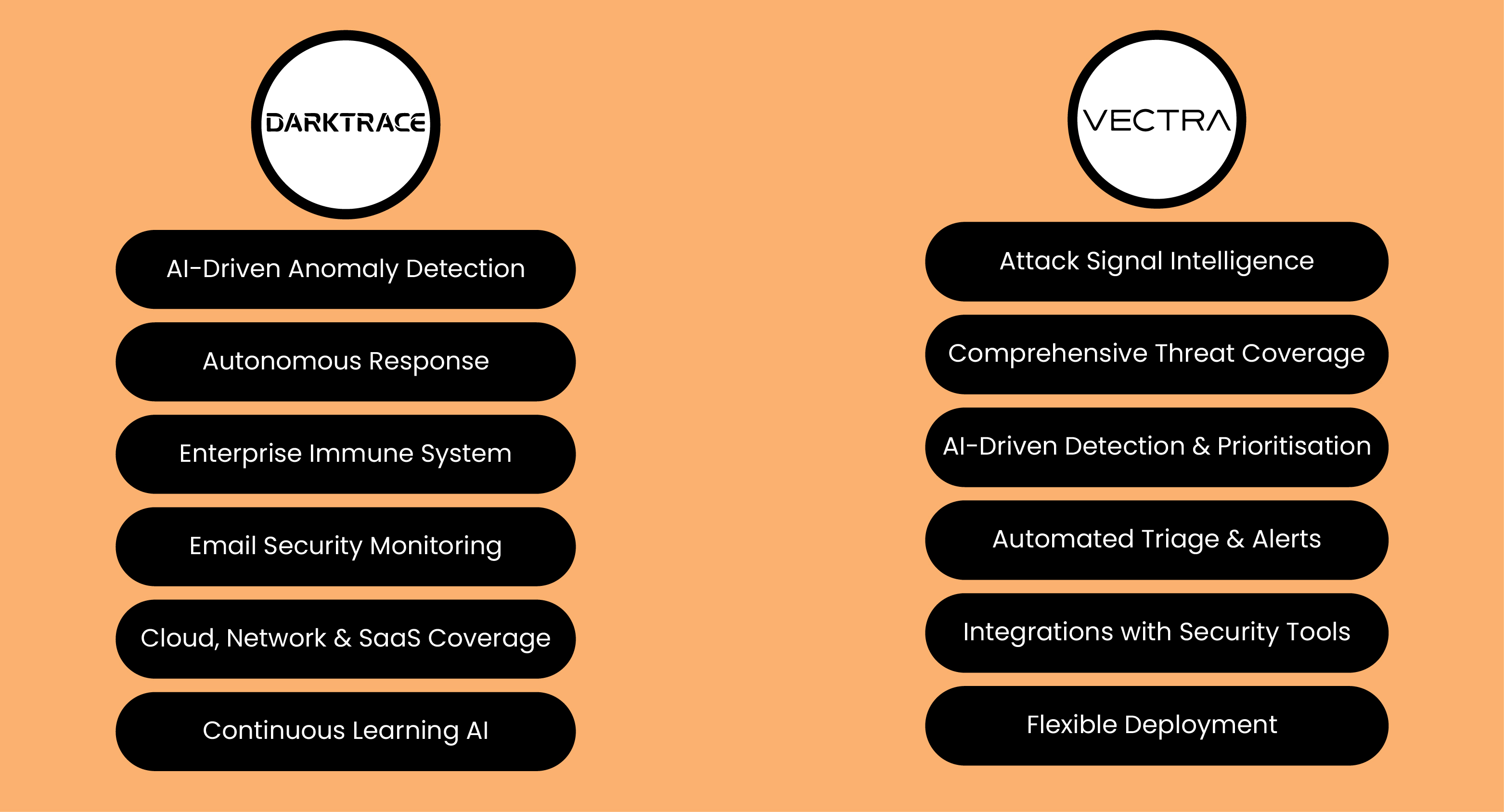
Here are some of the features of Vectra AI that makes them one of the best cybersecurity platforms:
|
Features |
Why they matter |
|---|---|
|
Attack Signal Intelligence. |
Correlates network, cloud, and identity signals to highlight real threats and reduce alert noise. |
|
Comprehensive Threat Coverage. |
Monitors on-premises networks, multi-cloud environments, identity systems, and SaaS security tools. |
|
AI-Driven Detection & Prioritisation. |
Detects ransomware, account takeovers, lateral movement, and APTs; ranks threats by urgency. |
|
Automated Triage & Alerts. |
Links related activities and highlights only high-impact incidents. |
|
Integrations with Security Tools. |
Works with SIEMs, SOARs, EDRs, and firewalls to streamline detection and response. |
|
Flexible Deployment. |
Supports on-premises, cloud, or hybrid setups; scalable for growing organisations. |
Pros and Cons of Vectra AI
Here are some pros and cons of Vectra AI:
|
Pros |
Cons |
|---|---|
|
Focuses on real threats to reduce alert fatigue. |
Needs experienced teams. |
|
Monitors network, cloud, and identity in one view. |
Can be expensive for smaller organisations. |
|
Detects sophisticated attacks beyond signatures. |
Some setups require manual work. |
Draktrace
Draktrace is one of the top machine learning and AI security tools for finding and stopping cyber threats in real time. Darktrace is a British‑origin cybersecurity platform that uses artificial intelligence and machine learning to detect, monitor, and respond to cyber threats inside an organisation. Rather than traditional antivirus tools, Darktrace builds a model of what is “normal” for a specific environment.
That environment alerts on or blocks weird behavior that may indicate a threat. It’s widely used to protect networks, cloud workloads, email, and SaaS apps.
Features of Darktrace
Here are some of the features of Darktrac that make it completely different from other NDR’s.
|
Features |
Why they matter |
|---|---|
|
AI‑Driven Anomaly Detection. |
Learns what’s normal for your network, then flags unusual activity in real time. |
|
Autonomous Response. |
Can automatically take action to contain threats based on AI analysis. |
|
Enterprise Immune System. |
Observes patterns over time to uncover hidden threats, including insider threats or unknown attacks. |
|
Email Security Monitoring. |
Detects and blocks phishing emails, malicious attachments, and compromised accounts. |
|
Cloud, Network & SaaS Coverage. |
Offers visibility across hybrid environments, including cloud and email platforms. |
|
Continuous Learning AI. |
The platform continuously adapts to changes in network behavior to improve detection. |
Pros and Cons of Darktrace
Here are the pros and cons of Draktrace:
|
Pros |
Cons |
|---|---|
|
Automatically adapts to your environment. |
Can be hard to configure and tune. |
|
The Antigena feature quickly contains threats. |
Expensive for smaller organisations. |
|
Monitors network, cloud, and email. |
Dashboard and alerts can be tricky at first. |
Vectra AI vs. Darktrace: Side-by-Side Features Comparison
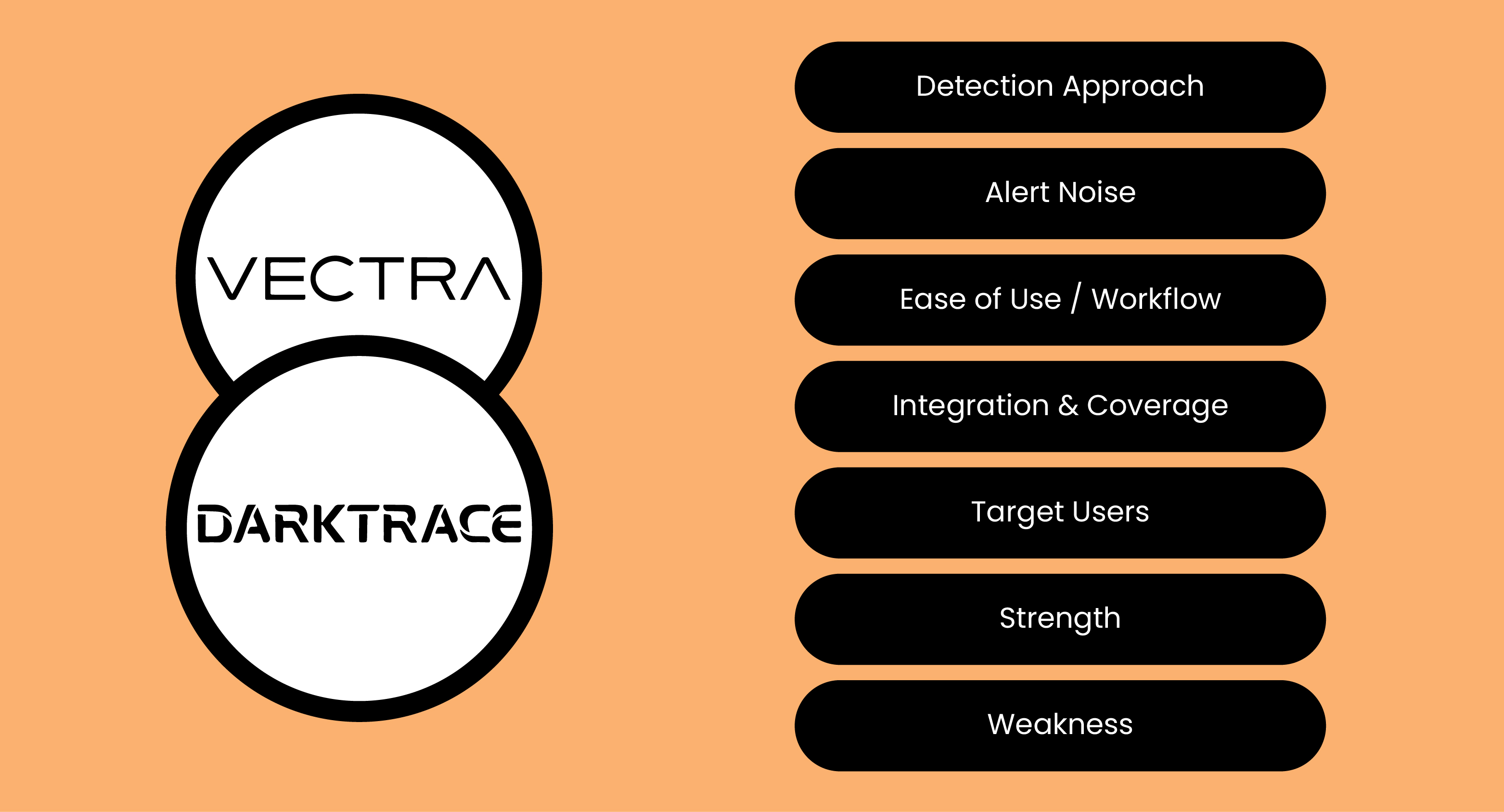
To select the best option for your needs, you need to compare them side by side based on their features, such as ease of use, detection approach, and any other features that matter. Then determine which one, between AI-Vectra and Darkatec, offers the best fit.
|
Features |
Vectra AI |
Darktrace |
|---|---|---|
|
Detection Approach. |
Focuses on real attacker behavior. |
Anomaly-based (flags unusual activity). |
|
Alert Noise. |
Low – prioritizes real threats. |
Higher – may include false positives. |
|
Ease of Use / Workflow. |
Easy prioritization; integrates well with SOC tools. |
Detailed insights may require interpretation and tuning. |
|
Integration & Coverage. |
Network, cloud, identity; strong SIEM/SOAR/EDR integration. |
Network, cloud, email, SaaS; broad visibility. |
|
Target Users. |
SOC teams, enterprises, MSSPs. |
Enterprises, SOCs, MSSPs, and I-focused environments. |
|
Strength. |
Clear signals, fewer false positives. |
Broad anomaly detection, adaptive learning. |
|
Weakness. |
May miss minor anomalies; specialized setup. |
Higher alert volume; requires tuning; false positives possible. |
Who Uses Them?
Here these NDRs are categories in typical users and industrial users:
Typical Users
Enterprise Security Teams
Large and mid-sized companies with dedicated security operations centers (SOCs) rely on these tools to monitor network traffic, detect threats, and respond quickly to incidents.
SOC Analysts
Security Operations Center professionals use these platforms to investigate alerts, prioritize threats, and protect sensitive data across the organisation.
Managed Security Service Providers (MSSPs)
Service providers often deploy Vectra AI or Darktrace to monitor multiple client networks and provide outsourced cybersecurity services.
Industrial Users
-
Healthcare & Hospitals: To protect patient data and medical devices from cyber threats.
-
Finance & Banking: To safeguard sensitive financial information and prevent fraud.
-
Government & Public Sector: To ensure critical infrastructure and citizen data are secure.
-
Technology & Cloud Providers: To monitor complex networks, cloud workloads, and SaaS applications.
-
Retail & Manufacturing: To secure payment systems, operational technology, and supply chains.
Factors Companies Should Consider When Choosing
Here are some factors companies should consider when choosing NDR.
|
Factors |
Consideration |
|---|---|
|
Security Team Maturity |
Mature SOCs may prefer Vectra AI; smaller teams might favor Darktrace. |
|
Alert Management |
Fewer, high-confidence alerts → Vectra AI; broad anomaly coverage → Darktrace. |
|
Environment Complexity |
Hybrid/multi-cloud networks and integrated systems need a platform that fits best. |
|
Integration Needs |
Both integrate with SIEM, SOAR, and other tools; workflow alignment is key. |
FAQs
What Is the Biggest Difference Between Darktrace and Vectra Ai?
Vectra focuses on network threat detection with guided response, while Darktrace emphasizes autonomous AI-driven threat monitoring across networks and the cloud.
What Types of Threats Can Each Platform Detect?
Both detect malware, insider threats, ransomware, and advanced persistent threats (APTs).
Which Platform Is More Cost-Effective?
Vectra is generally more affordable for enterprises; Darktrace can be pricier due to its broader set of autonomous AI features.
Choosing the right cybersecurity platform is crucial for effective threat detection and response, especially when it comes to choosing Vectra AI vs Darktrace. These platforms are best for protecting cloud security and cybersecurity against unauthorized access, damage, and disruption. The Vectra AI vs Darktrace comparison is quite clear, with the amazing features providing security to the organisation.
Vectra AI and Darktrace both offer AI-driven security but use different approaches. It works as an anti-phishing tool for detecting different types of phishing attacks. Vectra AI focuses on identifying real attacker behavior, providing high-fidelity alerts that help security teams prioritize genuine threats.
Vectra AI is ideal for organisations with mature security operations seeking clear insights and reduced alert noise. Darktrace excels at detecting anomalous behavior across an organisation’s environment, including networks, cloud systems, email, and SaaS applications.
Darktrace AI learns normal patterns over time and can spot unusual activity, even when the behavior does not match any known attack signatures. This makes Darktrace ideal for organisations seeking broad visibility and the ability to detect emerging, previously unseen threats.
If the organisation also targets customers in the EU, make sure they are aware of the Steps of comply with GDPR to stay fully aligned with global data privacy standards.
Stay tuned to Virtual Codes Vault for more updates about Vectra AI vs Darktrace.
